Aspirational Review
A Clarity Framework for reviewing and aligning on aspirational goals.
Purpose
You worked hard for six months. You believed you were doing well. Then the review came through and it was not what you expected. Not bad, exactly, but not what the work deserved. You find yourself wondering: Did my manager not see what I contributed? Did I misjudge what mattered? How did I get this so wrong?
Or you are the manager. You have an employee who did genuinely good work, but when calibration happened, you could not make the case land. You did not have the right examples at your fingertips. You could not articulate why this person's contributions mattered more than someone else's. You watched them get a rating that does not reflect what you know to be true — and you have to deliver that news.
Both of these experiences share a root cause: the narrative of contribution was constructed too late, from fragments, under pressure. By the time anyone tried to tell the story, the story was already over.
The Aspirational Review is a model for writing that story at the beginning, when ambitions are clear, energy is high and there is still time to shape the outcome. It answers a question that traditional goal-setting fails to address: What would a truly exceptional contribution look like — described in enough detail that I could actually work towards it?
Most professionals approach performance reviews backwards. They spend months working, then try to reconstruct a compelling narrative from whatever happened. The Aspirational Review inverts this. It asks you to write the review you want to earn, before you have earned it.
This is not goal-setting. Goals are targets. The Aspirational Review is a story. It imagines a future state in vivid detail: the problems you solved, the impact you created, the growth you demonstrated, the obstacles you overcame. It is the review your manager would write if everything went as well as it plausibly could.
The discipline is simple: write this review at the start of the cycle, share it with your manager and use the conversation that follows to ensure you are aiming at the right things.
Why Traditional Goal-Setting Falls Short
Goals are necessary but insufficient. They tell you what to aim at without telling you what success actually looks like when you get there. They invite defensive thinking:
- What does my manager expect of me?
- What can I commit to without risk of falling short?
- What is the minimum I need to do to earn the rating I want?
These questions are reasonable, but they produce reasonable outcomes — not exceptional ones.
The Aspirational Review invites different questions:
- What would an exceptional contribution actually look like?
- Six months from now, what am I most proud of having accomplished?
- What obstacles almost derailed me, and how did I overcome them?
- Whose perception of me shifted, and why?
These questions require imagination. And that imagination — applied at the start of the cycle rather than the end — changes what becomes possible.
Why This Is Easier Than It Sounds
Writing at the start of the cycle is fundamentally different from writing at the end. Your ambitions are fresh. Your energy is high. You are not defending what happened — you are imagining what could happen. The document writes itself because you are describing the future you want, not reconstructing a past you have half-forgotten.
The magazine cover test. Imagine that Fast Company or Wired wants to interview you at the end of the cycle about your exceptional contributions. What would you want to tell them? What accomplishments would make you genuinely proud to discuss? What obstacles would make for a compelling story?
This framing shifts the exercise from obligation to opportunity. You are not filling out a form. You are writing the story you want to live — and then going out to live it.
Most people find they can write an Aspirational Review in an hour or less. It front-loads a small investment of time and eliminates the anxiety that comes later.
The Aspirational Review in Practice
An Aspirational Review is a narrative, written in the past tense, describing what you contributed during a review period that has not yet happened. It is detailed enough to serve as a roadmap, honest enough to surface real challenges and ambitious enough to stretch what you believe is possible.
What it includes:
Contributions and impact. What did you accomplish? Be specific. Name the projects, the outcomes, the numbers. Describe not just what shipped but what changed because of it — for customers, for colleagues, for the business.
Growth demonstrated. What new capabilities did you develop? What did you do in month six that you could not have done in month one? How did your judgment, your skills or your influence expand?
Obstacles overcome. What nearly went wrong? What threatened to derail your progress? How did you navigate it? The best reviews acknowledge difficulty — they show that success was earned, not handed over.
Relationships and influence. Whose work did you enable? Who sees you differently now than they did at the start? What stakeholders did you surprise with how well you understood their needs?
Connection to what matters. How did your contributions connect to team and company goals? Why did this work matter beyond your own career? What would have been different if you had not done it?
An Example
Context: A senior product manager at a SaaS company, writing their Aspirational Review at the start of Q3/Q4.
Aspirational Review: H2 2025
This was the half where I moved from executing well to shaping direction.
The headline: I led the redesign of our onboarding flow, and it worked. New user activation improved from 34% to 52% — the largest single improvement in three years. More importantly, I identified the opportunity, built the case, assembled the cross-functional team and navigated significant pushback from stakeholders who believed onboarding was "good enough."
The project almost stalled in August. Engineering capacity was pulled to support an urgent infrastructure migration, and I had to choose between delaying launch or reducing scope. I made the call to cut two features from the initial release — features I had personally championed — to protect the timeline. It was the right decision. We launched on schedule, validated the core hypothesis and added the cut features in a fast follow six weeks later. My manager specifically noted my judgment on this trade-off in our calibration discussion.
Beyond onboarding, I became the person product leadership turned to when cross-functional alignment was stuck. I facilitated three planning sessions that had previously deadlocked, including the contentious roadmap prioritisation between Growth and Enterprise teams. I do not know if "facilitation" shows up in my formal goals, but several directors commented that I had become essential to making decisions actually happen.
What I learned: I am better at leading through influence than I gave myself credit for. I do not need a title or formal authority to shape outcomes. I also learned that saying no to my own ideas — cutting features I wanted — can be the most valuable thing I do.
This was the half I proved I am ready for the next level.
Using Your Aspirational Review
An Aspirational Review written in isolation has limited value. The power emerges when it becomes the basis for a conversation with your manager.
Share it early. Ask: Is this realistic? Are these the contributions the organisation will value most? What am I missing? What am I overestimating? The conversation is not a negotiation — it is a calibration. Discovering in month one that you are aiming at the wrong target is a gift. Discovering it in month six is a crisis.
When writing, a few principles help:
- Start with the outcome and work backwards. What would people say about your contributions if everything went well?
- Be specific. Name projects, metrics and stakeholders. Vague aspirations produce vague results.
- Include the struggle. A review with no obstacles overcome is either unrealistic or unambitious.
- Write in past tense. "I improved retention by 15%" forces more specificity than "I will improve retention."
The Aspirational Review and Impact Calibration
The Aspirational Review pairs naturally with Impact Calibration. They address different moments in the same cycle: the Aspirational Review establishes direction at the start; Impact Calibration keeps perception aligned throughout. Both stand on their own, but combined they become more powerful than either alone.
With an Aspirational Review in place, calibration conversations gain a shared reference point: "Are we on track for the review we imagined? What has changed?" The Aspirational Review also feeds into the Contribution Summary at the end of the cycle, providing a natural comparison between what was aimed at and what was delivered.
What the Aspirational Review Is Not
It is not a commitment. The Aspirational Review describes what success could look like, not what it will look like. Circumstances change. The best contributors pivot when the situation demands it. Treating the review as a binding contract defeats the purpose.
It is not a solo exercise. An Aspirational Review that never gets shared with a manager is just journalling. The value is in the conversation it enables.
Signs the Aspirational Review Is Working
- Manager and employee are aligned on what success means before work begins
- Calibration conversations reference the Aspirational Review as a shared baseline
- Employees discover early when their priorities are misaligned with the organisation's
- Reviews hold fewer surprises because the destination was agreed upfront
- Employees take ownership of their trajectory rather than waiting to be evaluated
Signs the Aspirational Review Is Broken
- Aspirational Reviews are written but never discussed with managers
- The conversation treats the review as a contract rather than a calibration tool
- Employees write aspirations that are safe rather than ambitious
- Reviews still surprise employees despite having written aspirations
- Aspirations are vague enough to be unfalsifiable
Summary
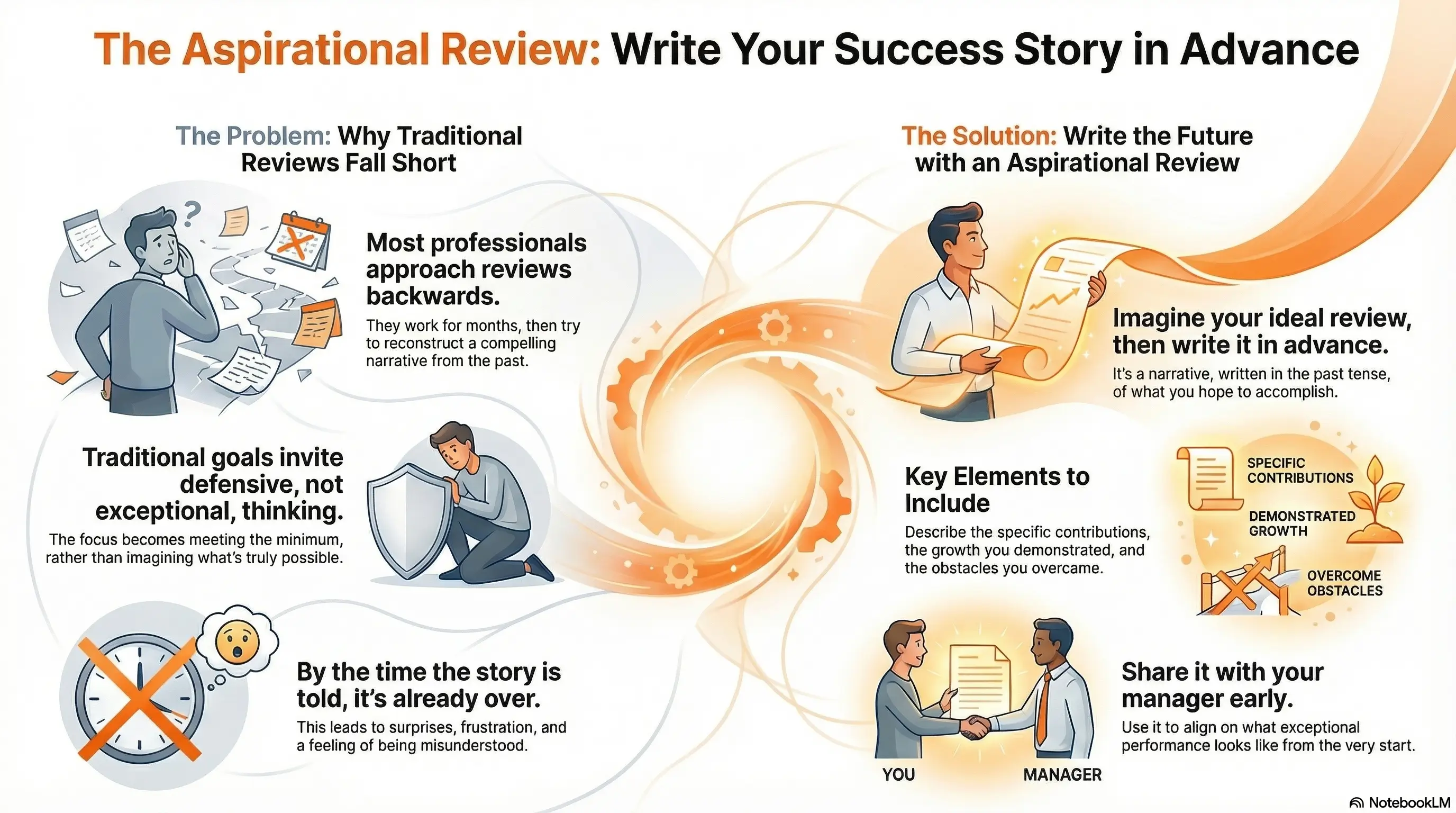
The Aspirational Review inverts the traditional approach to performance reviews: instead of waiting until the end to construct a narrative of contributions, you write the review you want to earn before you have earned it.
Written in isolation, it is useful. Shared with a manager, it becomes powerful — surfacing whether ambitions are aligned with what the organisation values and what support would make success more likely.
The discipline is simple: imagine success in vivid detail, share that vision early and use it to guide the work that follows. Your performance story is yours to write. The Aspirational Review is how you start writing it.
Want to bring clarity to your organization?
See how Clarity Forge can help transform your team.
Book a DemoStart Free TrialA discussion to see if Clarity Forge is right for your organization.
About the Author
 Michael O'Connor
Founder of Clarity Forge. 30+ years in technology leadership at Microsoft, GoTo and multiple startups. Passionate about building tools that bring clarity to how organisations align, execute, grow and engage.