Tradeoff Triangle
A Clarity Framework for managing project tradeoffs between scope, time and resources.
Purpose
The Trade-off Triangle is a model for agreeing - before problems arise - on how a project will handle the inevitable tension between scope, schedule and resources.
Every project makes promises about all three. We will deliver these features. By this date. With this team and budget. Then reality intervenes. Requirements shift. Dependencies slip. Key people leave. Unexpected complexity emerges.
When this happens, something has to give. The question is whether the team makes that trade-off consciously, guided by a shared understanding of what matters most, or reactively, one small compromise at a time, until the project drifts into a state no one intended.
The discipline is simple: before the project begins, agree on which constraint is sacrosanct, which is important and which has flexibility. This ranking becomes the framework for every trade-off that follows.
The Three Constraints
Every project operates within three fundamental constraints:
Scope — What are we trying to achieve? What features, capabilities or outcomes must be delivered for the project to be considered successful?
Schedule — When does this need to be done? Is there a fixed deadline? A product launch, a regulatory requirement, a contractual commitment?
Resources — What people, budget and tools do we have? What is the cost ceiling?
These constraints are interconnected. Expand scope without adjusting schedule or resources, and you are asking the team to do more with the same time and people. Compress the schedule without reducing scope, and you are asking for faster delivery of the same work. Reduce resources without adjusting the other two, and the math simply does not work.
None of these adjustments are impossible. All of them carry risk. The question is whether that risk is acknowledged and managed, or ignored until it becomes a crisis.
Why This Conversation Gets Skipped
Most stakeholders want all three constraints to be inviolable. They want the project delivered on time, on budget and with full scope. Asking them to prioritise feels like admitting defeat before starting — so the conversation gets skipped.
The team begins work with an implicit assumption that everything is equally important. When problems arise, trade-offs get made in the moment, without explicit agreement on what matters most. A feature gets descoped. A deadline slips. Contractors get added. Each decision may be reasonable in isolation. But over time, these incremental compromises open a gap between what stakeholders expect and what the project is actually delivering.
The cost of not having the conversation:
- Misaligned expectations. The team believes they are making sensible trade-offs. Stakeholders believe the original plan is intact. Both are surprised when reality emerges.
- Decision paralysis. Without a framework, every trade-off becomes a debate.
- Quality as the hidden variable. When scope, schedule and resources are all treated as fixed, the only thing left to flex is quality — corners get cut, technical debt accumulates, tests get skipped.
- Risk accumulation. Small compromises compound until a crisis forces a reckoning.
The Prioritisation Conversation
Before the project begins, gather the key stakeholders and agree on a ranking:
- Sacrosanct — This constraint cannot flex. If everything else falls apart, this one must hold.
- Important — This matters and should be protected, but can flex if necessary to protect the top priority.
- Flexible — This can be adjusted to accommodate changes in the other two.
How to frame the conversation:
Do not ask "What is most important?" in the abstract — stakeholders will say "all of it." Instead, pose concrete scenarios:
- "If we discover mid-project that the scope is larger than expected, do we extend the deadline, add resources or cut features?"
- "If a key team member leaves, do we slip the schedule, reduce scope or bring in a replacement at higher cost?"
- "If a critical dependency is delayed by four weeks, what gives?"
These scenarios force real prioritisation. They reveal assumptions that stakeholders may not have articulated — sometimes even to themselves.
Common priority patterns:
- Schedule-first: The deadline is immovable (product launch, regulatory requirement, contractual commitment). Scope and resources flex. Often means launching with minimum viable scope and iterating after.
- Scope-first: The outcome is what matters. A specific capability must exist, a particular problem must be solved. Time and resources adjust. Common for product-market fit or high-stakes technical migrations.
- Resource-first: The budget is fixed. Scope and schedule adjust to fit. Common in consulting engagements or fixed-bid contracts.
There is no universally correct answer. The right priority depends on context.
When Everything Is "Fixed"
What happens when stakeholders insist that all three constraints are immovable? The deadline cannot slip, the scope cannot shrink, the resources cannot grow.
Something still has to give. When the explicit constraints are frozen, the implicit ones flex:
Quality degrades. Tests get skipped. Edge cases get ignored. Technical debt accumulates. The product ships on time with the promised features — but it is fragile, buggy or poorly architected.
Risk increases. The project becomes brittle. There is no buffer for unexpected problems. Every issue becomes a potential crisis.
People burn out. When the math does not work, the difference is made up with overtime and heroics. The best people leave and the rest disengage.
You cannot actually freeze all three constraints. You can only pretend to. The prioritisation conversation is not about accepting failure — it is about choosing consciously where flexibility comes from, rather than having it extracted from quality, risk and people by default.
Living With the Framework
Agreeing on priorities at the start is necessary but not sufficient. The framework must be used throughout the project.
Reference it in status updates. When reporting progress, connect decisions to the agreed priorities. "We descoped feature X to protect the launch date, consistent with our schedule-first priority."
Use it in trade-off discussions. When a new issue arises, the first question should be: "Given our priorities, what is the right trade-off here?"
Revisit it when context changes. Sometimes underlying assumptions shift — a competitor launches early, a key customer commits. When context changes materially, revisit the prioritisation conversation.
Make it visible. Document the agreed priorities where the whole team can see them. The framework only works if people remember it exists.
The Trade-off Triangle and Agile
A reasonable objection: "We use agile. Scope is intentionally flexible. We do not commit to fixed feature sets."
This is true — and the Trade-off Triangle still applies.
Agile methods embrace scope flexibility by design. The backlog is prioritised, not promised. The team delivers what they can in each sprint, with the most important items first. This is, in effect, a schedule-first or resource-first model: time and team are fixed, scope adjusts.
The Trade-off Triangle simply asks you to be explicit about this priority structure rather than leaving it implicit. Even in agile contexts, trade-offs become acute: a major release has a committed date, a critical feature falls behind, the team is underwater. Agile does not eliminate these questions — it moves them from the project level to the iteration level. The Trade-off Triangle provides a framework for answering them consistently.
The Trade-off Triangle and Strategic Clarity
The Trade-off Triangle operates at the project level. But projects exist within a larger strategic context — and sometimes the two conflict.
A project team might decide scope is their top priority. But if the organisation has committed to a launch date that depends on this project, schedule may need to override scope regardless of what the team agreed.
This is where the Trade-off Triangle connects to The Alignment Stack. Projects that are well-aligned to strategic goals inherit some of their constraints from the strategy. When setting priorities for a project, ask: "What does the strategic context require?" The answer should inform — and sometimes override — local preferences.
Signs the Trade-off Triangle Is Working
- Trade-off decisions are fast because the framework provides clear guidance
- Stakeholders are rarely surprised by project adjustments
- The team makes decisions confidently without escalating every issue
- Status updates reference the agreed priorities explicitly
- Quality is protected because something else is allowed to flex
- Post-mortems reveal that trade-offs were made consciously, not by default
Signs the Trade-off Triangle Is Broken
- Every trade-off becomes a debate because no one agreed on priorities upfront
- Stakeholders are surprised by scope cuts, delays or cost overruns
- The team is paralysed, afraid to make decisions without explicit approval
- Quality degrades invisibly as the team cuts corners to meet impossible constraints
- Heroics and overtime become the norm
- Different stakeholders have different mental models of what was promised
Summary
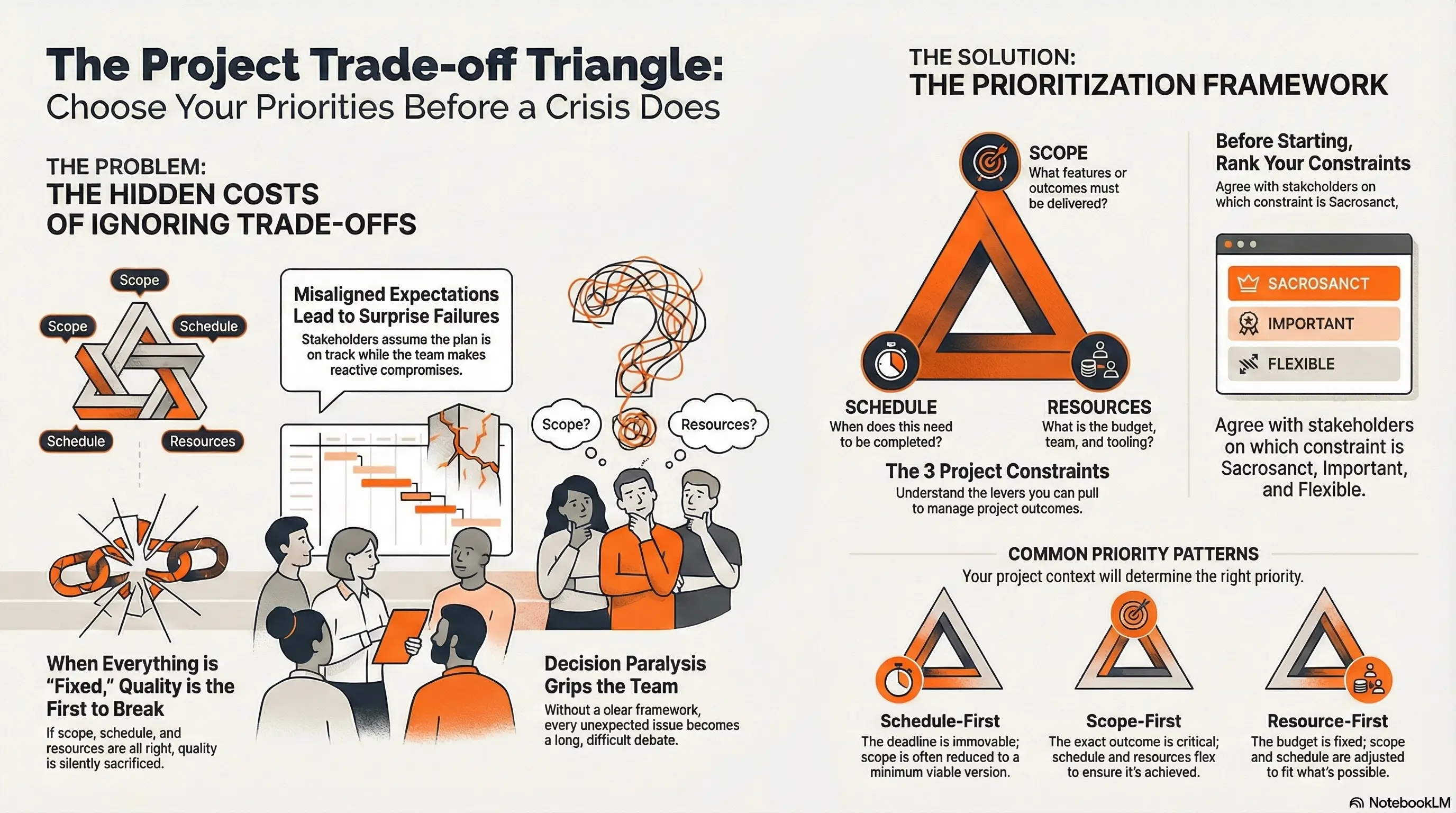
The Trade-off Triangle is a model for agreeing — before problems arise — on how a project will navigate the tension between scope, schedule and resources.
Every project makes promises about all three. Reality rarely cooperates. When problems arise, something has to give. The discipline is simple: before the project begins, agree on which constraint is sacrosanct, which is important and which has flexibility.
When stakeholders insist all three are fixed, they are not actually fixing them — they are forcing flexibility into the hidden variables. Quality degrades, risk increases and people burn out. The Trade-off Triangle makes this dynamic visible and gives stakeholders a real choice.
Proactive prioritisation is risk management. It keeps the team aligned, stakeholders informed and quality protected. It is also respect — for the team who will do the work and the reality that every project will face moments when something has to give.
Want to bring clarity to your organization?
See how Clarity Forge can help transform your team.
Book a DemoStart Free TrialA discussion to see if Clarity Forge is right for your organization.
About the Author
 Michael O'Connor
Founder of Clarity Forge. 30+ years in technology leadership at Microsoft, GoTo and multiple startups. Passionate about building tools that bring clarity to how organisations align, execute, grow and engage.