Alignment Stack
Ensuring the work people do actually moves the numbers that matter.
Purpose
The Alignment Stack is a model for building organisational focus from the top down. It answers a deceptively simple question: How do we ensure that the work people do actually moves the numbers that matter?
Most organisations get this backwards. They start with projects — things people want to build or fix — and then retrofit goals to justify them. The result is a portfolio of work that feels busy but produces surprisingly little measurable progress.
The Alignment Stack inverts this. It starts with metrics, because metrics force the conversations that matter most: What does success actually look like? How would we know if we were winning?
The Core Cascade
The Alignment Stack flows in one direction:
Metrics → Goals → Teams → Projects
Each layer depends on the one above it. Each layer exists to serve the one above it.
1. Metrics
Metrics are the foundation. They are the small number of measurable outcomes that define organisational health and progress.
Defining your metrics is not an administrative exercise, it is one of the most important strategic conversations an organisation can have. The debate about what to measure forces leaders to articulate what they actually value. It surfaces hidden assumptions. It exposes disagreements that would otherwise play out as conflicting priorities downstream.
Good metrics share a few qualities:
- They measure outcomes, not activity
- They are few enough to remember (typically 3–7 at the company level)
- They are stable enough to track over time, but not so rigid they become irrelevant
- They create clarity about trade-offs: if two metrics conflict, which wins?
The goal is not a perfect measurement system. The goal is a shared language for what success looks like.
2. Goals
Goals are desired changes in your metrics. They answer the question: What are we trying to improve, and by how much, in what timeframe?
This is where many organisations go wrong. They define goals as initiatives ("Launch the new platform") or activities ("Improve customer engagement") rather than outcomes tied to measurement.
A well-formed goal in the Alignment Stack:
- Names the metric(s) it intends to move
- Specifies the direction and magnitude of change
- Has a time horizon
- Is achievable given current constraints (or explicitly challenges those constraints)
Goals are not aspirations. They are commitments to move specific numbers. If a goal cannot be expressed as a change in a metric, it is either the wrong goal or you are missing a metric.
3. Teams
Teams are how you allocate resources to goals.
Once you know your metrics and the goals you are pursuing against them, you face a resource question: Who is working on what? The Alignment Stack treats team formation and assignment as a strategic act, not an organisational inheritance.
This does not mean reorganising constantly. It means being explicit about which teams own which goals — and being honest when a team's mandate has drifted from the goals that justify its existence.
Questions the Alignment Stack forces:
- Which goals does this team exist to pursue?
- Does this team have the capacity and capability to pursue those goals?
- If a team is not clearly mapped to a goal, why does it exist?
4. Projects
Projects are the units of work that teams execute to achieve goals.
In a well-aligned organisation, every project can answer three questions:
- What goal does this project serve?
- What metric will move if this project succeeds?
- How will we know if it worked?
Projects that cannot answer these questions are not necessarily bad, but they are unaligned. They represent effort that may or may not contribute to what the organisation says it cares about.
The discipline of the Alignment Stack is not to eliminate all unaligned work (more on that below), but to know how much of your portfolio is aligned and how much is not.
Why Metrics First?
The Alignment Stack is opinionated: it insists that metrics come before goals, not after.
This is counterintuitive. Most planning processes start with vision, then strategy, then goals, then metrics (if at all). Metrics feel like an afterthought, a way to track progress on decisions already made.
But starting with metrics changes the conversation. It forces leaders to answer:
- What would we measure if we could only measure a few things?
- What does "better" actually mean for this organisation?
- Where do our intuitions about success conflict with each other?
These are alignment conversations disguised as measurement conversations. They surface the strategic disagreements that otherwise remain hidden until they explode in execution.
A team that has genuinely agreed on its metrics has done half the work of alignment. The goals, teams and projects that follow are logical consequences of that agreement.
The Alignment Ideal
The Alignment Stack describes an ideal state: every project traces to a goal, every goal traces to a metric, every team knows what it owns and why.
No organisation achieves this perfectly. But the degree to which you approach it determines your ability to move quickly and execute against your strategy.
Consider two organisations with identical headcount and identical goals:
- Organisation A has 80% of its work cleanly mapped to its stated goals
- Organisation B has 40% of its work cleanly mapped
Organisation A can redirect resources, measure progress and make trade-offs with confidence. Organisation B is flying partially blind, it cannot say with certainty what its people are actually working towards.
The Alignment Stack is not about perfection. It is about visibility. The goal is to know, at any moment, how much of your organisational capacity is aligned to your stated priorities and to make conscious decisions about the rest.
Work Outside the Stack
Not all work fits neatly into the Metrics → Goals → Teams → Projects cascade. Two categories deserve explicit attention: Business as Usual (BAU) and Shadow Work.
Business as Usual (BAU)
BAU is the ongoing, non-negotiable work that keeps the organisation running. It is not tied to a specific goal or time-bound initiative, it simply needs to happen.
Examples:
- Customer support answering calls and emails
- Finance processing payroll and invoices
- IT maintaining infrastructure and security
- Legal reviewing contracts
BAU is real work. It consumes capacity. It must be accounted for when planning what else the organisation can take on.
The Alignment Stack does not ignore BAU, it contextualises it. Even ongoing operational work exists in relationship to metrics and goals:
- Customer support contributes to customer satisfaction metrics, even if there is no active "project" to improve them
- IT maintenance contributes to uptime and security metrics
- Finance operations contribute to compliance and accuracy metrics
The question is not whether BAU matters, the question is whether this particular BAU is still necessary and valuable.
The BAU Audit
Over time, BAU accumulates. Processes that made sense five years ago persist because no one has questioned them. Internal systems that were once essential become legacy burdens. Reports that no one reads continue to be produced.
Healthy organisations periodically audit their BAU:
- Is this work still necessary?
- Is this still the best way to accomplish this outcome?
- What would happen if we stopped doing this?
BAU that cannot justify itself against current metrics and goals is a candidate for elimination or transformation. The Alignment Stack provides the lens: if this work does not contribute to a metric we care about, why are we still doing it?
Shadow Work
Shadow work is more insidious. It consists of projects that pursue goals not defined in the accepted narrative, or goals that actively conflict with the stated strategy.
Shadow work takes many forms:
- Pet projects: Work that a leader or team finds interesting but that does not connect to organisational priorities
- Power projects: Work undertaken to build influence, protect territory or undermine rivals
- Insurance projects: Work done "just in case" leadership changes its mind or the strategy shifts
- Legacy projects: Work that continues because stopping it would mean reducing headcount - and very few leaders willingly shrink their teams. This same dynamic sustains legacy BAU: processes persist not because they are valuable but because they justify roles.
- Belief-driven projects: Work undertaken by people who genuinely believe they are solving a critical problem, one that leadership has either deprioritised or failed to recognise. These projects are not cynical; they reflect a gap between what the organisation says matters and what some of its people believe should matter. Surfacing this type of shadow work creates an opportunity: the alignment conversation that should have happened earlier.
Shadow work is not always malicious. Sometimes it reflects genuine disagreement about strategy. Sometimes it is a rational response to an organisation that changes direction too often. Sometimes it is simply inertia.
But shadow work is always costly. It consumes resources that could be applied to aligned work. It creates confusion about what the organisation actually values. It signals that the stated strategy is not the real strategy.
Surfacing Shadow Work
The Alignment Stack makes shadow work visible by asking a simple question of every project: What goal does this serve, and what metric will it move?
Projects that cannot answer this question are either:
- Missing a goal (the goal exists but has not been articulated)
- Missing a metric (the goal is real but not measured)
- Unaligned (the work does not serve the stated strategy)
The goal is not to eliminate all shadow work through enforcement. That approach drives it underground. The goal is to make it visible, name it and decide consciously what to do about it.
Sometimes the right answer is to stop the work. Sometimes the right answer is to change the strategy to accommodate it. Sometimes the right answer is to acknowledge that a certain amount of exploration and experimentation will always exist outside the formal structure.
What matters is that leadership knows and that the organisation does not deceive itself about where its resources are actually going.
Applying the Alignment Stack
For Leaders
- Start with metrics. Invest the time to define and debate them. Do not delegate this conversation.
- Express goals as changes in metrics. Reject goals that cannot be measured.
- Be explicit about team mandates. Every team should know which goals it owns.
- Audit projects regularly. Ask what goal each project serves and what metric it will move.
- Account for BAU. Know how much capacity it consumes and whether it is still justified. Consider tracking the ratio of resources dedicated to BAU versus goal-oriented work — and actively managing that number. The goal is not to eliminate BAU, but to create pressure toward more capacity flowing into strategic initiatives over time.
- Surface shadow work. Create safety for people to name it, then decide what to do about it.
For Teams
- Know your goals. If you cannot name the 1–3 goals your team exists to pursue, ask.
- Trace your projects. Every project should connect to a goal and a metric. If it does not, raise it.
- Protect your capacity. BAU is real. Account for it when committing to new work.
- Name your shadow work. If you are doing work that does not fit the stated strategy, be honest about it.
For Individuals
- Understand how your work connects. Can you trace your current tasks to a goal and a metric?
- Ask the alignment question. When assigned new work, ask what goal it serves.
- Flag disconnects. If you are doing work that seems misaligned, say so. You may be seeing something leadership has missed.
The Alignment Stack in Practice
The following examples show how the Alignment Stack applies to different business models and different levels of the organisation.
Company-Level Examples
Example 1: B2B SaaS Company
Company context: A project management SaaS with 200 employees, $25M ARR, selling to mid-market companies.
Metrics (North Stars)
- Annual Recurring Revenue (ARR)
- Net Revenue Retention (NRR)
- Customer Acquisition Cost (CAC) Payback Period
- Product Engagement Score (composite of weekly active users, feature adoption and session depth)
Goals (Current Quarter)
- Increase NRR from 105% to 112%
- Reduce CAC payback from 18 months to 14 months
- Increase Product Engagement Score from 62 to 70
Teams → Goals Mapping
- Customer Success → NRR (retention and expansion)
- Product & Engineering → Product Engagement Score, NRR (feature value)
- Marketing → CAC Payback (demand generation efficiency)
- Sales → CAC Payback (deal velocity and size)
Projects (Examples)
- Customer Success: Launch proactive health scoring system to identify at-risk accounts 90 days before renewal → serves NRR goal
- Product: Rebuild onboarding flow to reach "aha moment" in first session → serves Product Engagement Score
- Marketing: Shift 30% of paid spend to bottom-funnel content campaigns → serves CAC Payback
- Sales: Implement mutual action plans for enterprise deals → serves CAC Payback (faster close)
Example 2: Online Services Marketplace
Company context: A two-sided marketplace connecting freelance designers with businesses, 150 employees, $40M GMV annually.
Metrics (North Stars)
- Gross Merchandise Value (GMV)
- Take Rate (platform revenue as % of GMV)
- Liquidity Rate (% of posted jobs that result in a successful match within 7 days)
- Supply Quality Score (composite of designer ratings, on-time delivery and repeat hire rate)
Goals (Current Quarter)
- Increase GMV from $40M to $46M (annualised run rate)
- Improve Liquidity Rate from 64% to 72%
- Maintain Take Rate at 18% (resist pressure to discount)
- Increase Supply Quality Score from 4.2 to 4.4
Teams → Goals Mapping
- Supply Growth → GMV (more designers = more capacity)
- Demand Marketing → GMV, Liquidity Rate (more buyers, better matching)
- Product & Engineering → Liquidity Rate, Supply Quality Score (matching algorithm, quality tools)
- Trust & Safety → Supply Quality Score (vetting, dispute resolution)
Projects (Examples)
- Supply Growth: Launch referral programme targeting designers in underserved categories (motion graphics, 3D) → serves GMV
- Product: Implement skill-based matching algorithm to surface better-fit designers faster → serves Liquidity Rate
- Trust & Safety: Introduce portfolio verification badges for top-tier designers → serves Supply Quality Score
- Demand Marketing: Launch "first project guarantee" for new business buyers → serves GMV and Liquidity Rate
Example 3: Professional Services Firm
Company context: A management consulting firm with 80 consultants, $18M revenue, serving mid-market companies on operational transformation.
Metrics (North Stars)
- Revenue
- Consultant Utilisation Rate (billable hours as % of available hours)
- Client Net Promoter Score (NPS)
- Revenue per Consultant
Goals (Current Quarter)
- Increase revenue from $18M to $20M (annualised)
- Improve utilisation from 68% to 75%
- Maintain Client NPS above 55
- Increase revenue per consultant from $225K to $250K
Teams → Goals Mapping
- Business Development → Revenue (new clients, expanded engagements)
- Delivery (by practice area) → Utilisation Rate, Client NPS, Revenue per Consultant
- Talent & Staffing → Utilisation Rate (matching consultants to projects)
- Marketing → Revenue (brand, thought leadership, inbound leads)
Projects (Examples)
- Business Development: Launch structured account planning for top 20 clients to identify expansion opportunities → serves Revenue
- Delivery: Develop reusable diagnostic frameworks to reduce project startup time by 20% → serves Utilisation Rate, Revenue per Consultant
- Talent & Staffing: Implement skills-based staffing model to reduce bench time → serves Utilisation Rate
- Marketing: Publish quarterly industry benchmarking report to drive inbound leads → serves Revenue
Team-Level Example: Enabling Teams and the Alignment Stack
Engineering Manager: Core Platform Team
Context: You manage the Core Platform team — 8 engineers responsible for the shared infrastructure that other product teams build on. Your company is the B2B SaaS from Example 1. The company's north-star metrics are ARR, NRR, CAC Payback and Product Engagement Score.
The Challenge for Enabling Teams
Platform teams do not directly own business metrics. You do not close deals or retain customers. Your work is one or two steps removed from the metrics that leadership talks about.
This creates a temptation to opt out of the Alignment Stack: "We're infrastructure, we just support everyone else."
That is a mistake. It makes your team's value invisible and your priorities subject to whoever shouts loudest. The Alignment Stack applies to enabling teams, it just requires translating company metrics into team-level metrics that capture your contribution.
Step 1: Connect to Company Goals
Start by asking: Which company goals does my team's work affect?
For a Core Platform team, the connections might be:
- Product Engagement Score — Platform performance (speed, reliability) directly affects user experience. If the app is slow, engagement drops.
- NRR — Platform stability affects customer satisfaction and retention. Outages and bugs drive churn.
- CAC Payback — Platform developer productivity affects how fast product teams can ship features that attract and convert customers.
You do not own these metrics, but you contribute to them. Your job is to define team-level metrics that capture that contribution.
Step 2: Define Team-Level Metrics
Your team-level metrics should:
- Be within your control (not dependent on other teams' decisions)
- Have a plausible causal link to company metrics
- Be measurable with data you can actually access
Core Platform Team Metrics:
| Team Metric | What It Measures | Links to Company Metric |
|---|---|---|
| API Response Time (p95) | Platform performance | Product Engagement Score |
| Platform Uptime | Reliability | NRR (customer satisfaction) |
| Deployment Frequency | Developer productivity | CAC Payback (faster shipping) |
| Time to Onboard New Service | How easily product teams can build on the platform | CAC Payback (faster shipping) |
| Incident Count (Sev 1 & 2) | Stability | NRR, Product Engagement Score |
These are your north-star metrics. They are what success looks like for your team.
Step 3: Set Team Goals
Goals express desired changes in your metrics. For the current quarter:
- Reduce API response time (p95) from 320ms to 200ms
- Maintain platform uptime at 99.95% or above
- Increase deployment frequency from 12/month to 20/month (company-wide)
- Reduce average time to onboard a new service from 3 weeks to 1 week
- Reduce Sev 1 & 2 incidents from 4/month to 2/month
Each goal is measurable, time-bound and connected to a metric.
Step 4: Trace Projects to Goals
Every project your team takes on should connect to a goal:
- Performance: Implement caching layer for high-traffic API endpoints → serves API response time goal
- Reliability: Build automated failover for database cluster → serves uptime goal
- Developer Experience: Create self-service provisioning for new microservices → serves service onboarding goal
- Developer Experience: Migrate CI/CD pipeline to new tooling → serves deployment frequency goal
When someone proposes a project that does not trace to a goal, you have a decision to make. Maybe the project reveals a missing goal. Maybe it is shadow work. Either way, the Alignment Stack forces the conversation.
Communicating Up and Across
The Alignment Stack gives you a language for communicating your team's value to leadership and peer teams:
To leadership: "Core Platform exists to improve product performance, platform reliability and developer productivity. This quarter we're targeting a 40% improvement in API response time and doubling deployment frequency. These directly support Product Engagement and CAC Payback."
To peer teams: "We can take on your request to build a new authentication service. That maps to our service onboarding goal. Based on current capacity, we can start in three weeks. If you need it sooner, help me understand which company goal it serves and we can discuss reprioritisation."
When asked to do unaligned work: "That is an interesting idea. Help me understand which of our team goals it would serve — or which company metric it would move. If it does not fit our current goals, we should discuss whether the goals need to change or whether this should wait."
What These Examples Show
Metrics vary by business model and team function, but the principle holds. A SaaS company cares about ARR and retention; a marketplace cares about liquidity and GMV; a services firm cares about utilisation. A platform team cares about performance, reliability and developer productivity. In each case, a small set of metrics defines what winning looks like.
Enabling teams can and should use the Alignment Stack. Teams that do not directly own business metrics must translate company goals into team-level metrics that capture their contribution. This makes their value visible and their priorities defensible.
Goals express desired change. "Reduce API response time from 320ms to 200ms" is a goal. "Improve platform performance" is not.
Teams exist to pursue goals. When a team cannot articulate which metrics it is accountable for, something is misaligned — either the team structure or the goal clarity.
Projects trace to metrics. Every project in these examples can answer "what metric will move if this succeeds?"
Signs the Alignment Stack Is Working
- Leaders can name the organisation's north-star metrics without hesitation
- Goals are expressed as measurable outcomes, not activities
- Teams have clear ownership of specific goals
- Projects are visibly linked to the goals and metrics they serve
- BAU is accounted for in capacity planning
- Shadow work is acknowledged and consciously managed
- Trade-off conversations reference metrics: "If we do X, we are prioritising metric A over metric B"
- New initiatives are evaluated against the stack: "What metric does this move?"
Signs the Alignment Stack Is Broken
- Every initiative is a "top priority"
- Goals describe activities ("launch X") rather than outcomes ("improve Y by Z%")
- Teams cannot articulate which goals they own
- Projects exist without clear connection to metrics
- BAU consumes most capacity but is invisible in planning
- Shadow work is widespread but undiscussed
- Trade-offs are made politically rather than strategically
- New initiatives are approved based on enthusiasm rather than alignment
Summary
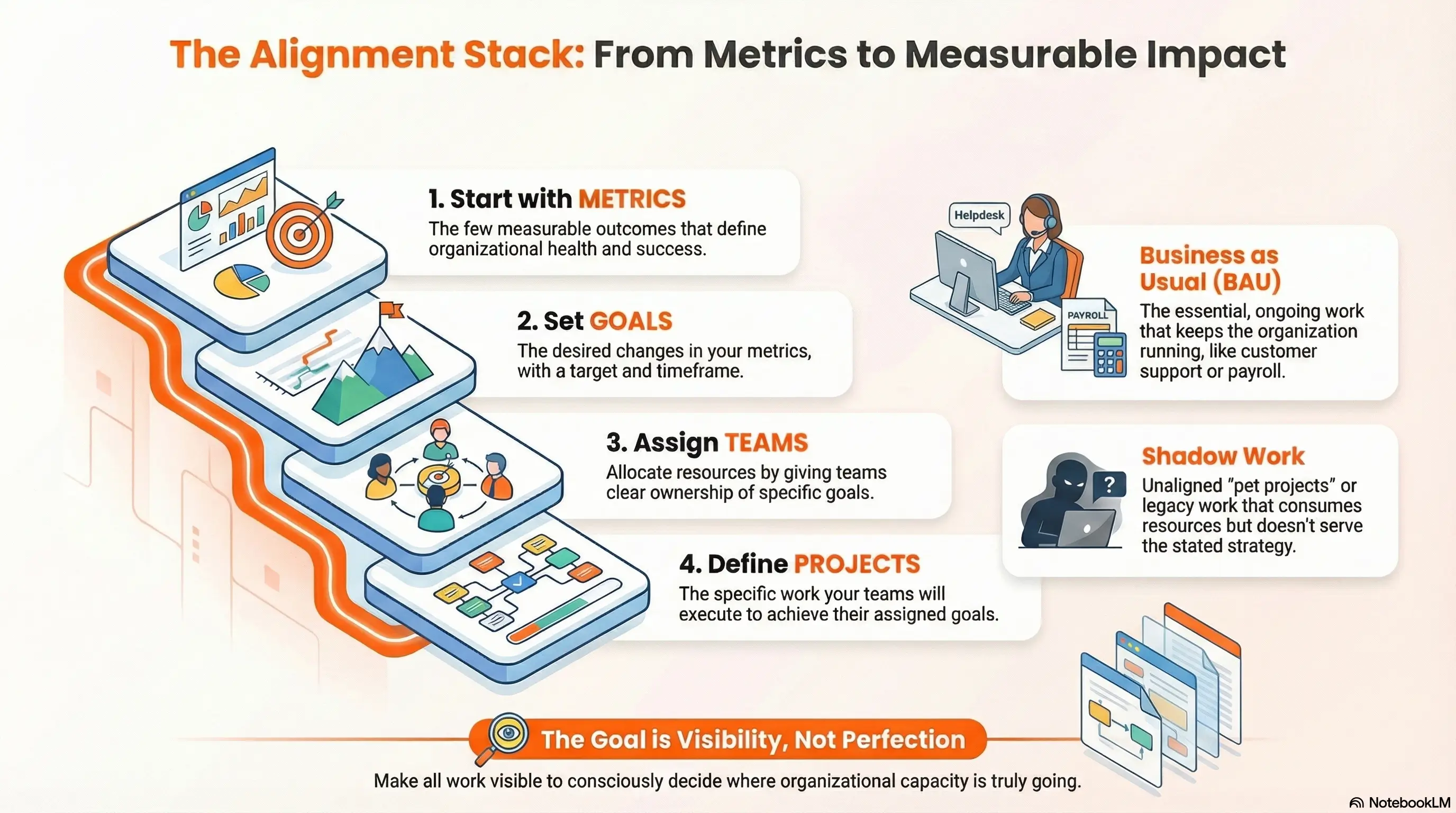
The Alignment Stack is a discipline for connecting strategy to execution. It flows from metrics to goals to teams to projects — each layer serving the one above.
It acknowledges that not all work fits this structure. BAU must be accounted for. Shadow work must be surfaced. But the goal is visibility: knowing how much of your organisational capacity is aligned to your stated priorities and making conscious decisions about the rest.
Organisations that master the Alignment Stack can move faster, make better trade-offs and execute with confidence. They spend less time debating what matters because they have already done that work — in the metrics conversation that started it all.
Want to bring clarity to your organization?
See how Clarity Forge can help transform your team.
Book a DemoStart Free TrialA discussion to see if Clarity Forge is right for your organization.
About the Author
 Michael O'Connor
Founder of Clarity Forge. 30+ years in technology leadership at Microsoft, GoTo and multiple startups. Passionate about building tools that bring clarity to how organisations align, execute, grow and engage.