Product Mindset
Treating projects as products worth owning, branding and selling.
Purpose
Watch a project manager take on a new project. Often the first thing they do is schedule a meeting to "gather requirements." They ask stakeholders what they want. They document it. They break it into tasks, assign owners and build a timeline. Then they spend the next six months asking people for status updates and chasing down blockers.
This is facilitation, not ownership. The project manager has become a coordinator of other people's intentions rather than an owner of a problem worth solving.
The best project managers operate differently. They do not wait for someone else to define the purpose. They dig into the problem until they understand it deeply, often better than the stakeholders who requested the project. They shape the solution, not just the schedule. They build a case for why this project matters, attract resources and keep stakeholders invested. They think like product managers.
This is the Product Mindset: treating every project as a product, with a problem to solve, a value proposition, customers to serve, a brand to build and a lifecycle to manage. It transforms project management from task coordination into problem ownership. And it makes projects visible in a way that serves the organisation: easy to understand, easy to evaluate, easy to stop when the value is gone.
What Projects and Products Share
Projects are often viewed tactically - tasks, deadlines, resources, budget - but at their core, projects and products have more in common than most people recognise.
Both exist to solve a problem. Both need a value proposition to attract investment and maintain momentum. Both have customers - products call them users, projects call them stakeholders. Both need success metrics. Both have lifecycles, including knowing when to stop.
When you see these parallels, the question shifts. It is no longer "how do I manage this project?" It becomes "how do I make this project succeed the way a great product succeeds?"
The Project Brand
Great products have clear identities. They stand for something. People can describe them in a sentence. The same should be true for your projects.
A project brand is not a logo or a colour scheme, though those can help. It is the answer to a set of questions that, if you cannot answer them, you probably should not be running the project:
-
What problem are we solving? Not what are we building or delivering, what problem are we solving? For whom? Why does it matter?
-
What is the value proposition? Why should the organisation invest in this? What do stakeholders get in return? What changes if we succeed?
-
What makes this worth doing now? Why this project, at this moment, with these resources? What is the cost of waiting or not doing it at all?
-
What is the identity? Does the project have a name that people remember? A narrative they can repeat? A clear enough purpose that team members can explain it to someone outside the project in thirty seconds?
A strong project brand does several things at once:
It rallies support. People want to be part of something that matters. A project with a clear identity attracts resources, talent and executive attention. A project that is "just a collection of deliverables" does not.
It creates accountability. When everyone knows what the project is for, they can evaluate whether it is working. A branded project is easier to hold accountable than a vague initiative.
It enables pruning. When it comes time to review the portfolio - to decide what to stop, pause or accelerate - projects with clear brands are easy to evaluate. Projects without brands hide in the noise until someone notices they have been consuming resources for years without clear value.
The brand is not decoration. It is the foundation.
Marketing Your Project
Even the best products do not sell themselves. Projects are no different.
Your stakeholders are your customers. They have competing demands on their attention. They will forget about your project if you let them. They will question its importance if you do not keep making the case.
Status updates as value reinforcement. Every update is an opportunity to remind stakeholders why this project matters. "We completed the API integration" is task reporting. "We completed the API integration, which means customers can now sync their data in real time, which is a core promise of this project" is marketing.
Design the stakeholder experience. Everyone who interacts with your project is a user. How are they introduced to it? How do they get value from it? Can they give feedback? Would they recommend it to colleagues? A project that frustrates its users will struggle regardless of how well the tasks are managed.
Maintain momentum. Projects lose energy. It is natural. Recognise when engagement is fading and do something about it - a demo, a milestone celebration, a reminder of the stakes.
The project manager who says "I should not have to sell this, the value is obvious" is the project manager whose project will eventually be deprioritised without warning.
Lifecycle Thinking
Great product managers know when a product is no longer serving its market and make hard decisions about pivoting or sunsetting. Project managers need the same discipline.
At initiation, ask: Is the problem clear? Is the value proposition compelling? Many projects should die here, before resources are committed to something that was never going to work.
During execution, revisit the fundamentals regularly. Is the value proposition still valid given what we have learned? Has something changed that undermines the original case?
At decision points, ask the hard question: should this project still exist? Not every project should reach completion. Some should be stopped because the problem changed, the value evaporated or a better solution emerged.
This connects directly to Portfolio Discipline. Projects with clear brands are easy to evaluate. Projects without them linger indefinitely, consuming resources without anyone quite knowing why.
The Visibility Effect
Here is something project managers rarely consider: how will you describe this work when your performance review comes around?
Employees routinely struggle to articulate their value at review time. They know they contributed. But when asked to summarise their impact, they fumble — because the work was never framed in a way that made it memorable or attributable.
Well-branded projects solve this problem. You are not "the person who worked on that integration thing." You are "the person who led Project Atlas, which solved the data fragmentation problem and reduced support tickets by 40%."
This compounds in calibration. When your manager advocates for you, they need a story, and they are telling it to people who may never have worked with you. "She owned Project Atlas" is easier to remember and defend than "she worked on some important backend infrastructure."
When work is well-branded, everyone who contributed gets a share of the recognition. When it is not, the work disappears into the background noise. The Product Mindset does not just serve the organisation, it serves the careers of everyone who does the work.
A Practical Checklist
For project managers taking on a new project:
Before you start:
- Do I understand this problem deeply enough to have my own opinions about it?
- Can I explain why this problem matters, not just what we are building?
- Do I know who should be a stakeholder, or am I just accepting whoever showed up?
- Is there a clear value proposition why this project is worth doing now?
- Does the project have a name and identity people will remember?
During execution:
- Am I marketing the value of the project or just reporting status?
- What is the user experience my stakeholders have engaging with this project?
- Is the value proposition still valid given what we have learned?
- Am I in love with the problem, or have I become attached to the solution?
At decision points:
- Should this project continue, pivot or stop?
- If we were starting today with what we now know, would we start this project?
- Has the problem changed? Has a better solution emerged?
Signs the Product Mindset Is Working
- Project managers can articulate the problem and value proposition without hesitation
- Projects have identities that stakeholders recognise and remember
- Status updates reinforce value, not just report activity
- Portfolio reviews can quickly assess which projects are delivering value
- Projects get stopped when the value proposition no longer holds
- Project managers are seen as problem owners, not task coordinators
- Contributions are easy to articulate at review time because projects have clear identities
Signs the Product Mindset Is Broken
- Projects are defined by deliverables, not problems
- Project managers wait for stakeholders to define purpose
- No one can explain why a project matters in a sentence
- Status updates are task lists with no connection to value
- Zombie projects consume resources because no one evaluates them
- Project managers are seen as facilitators, not owners
- Employees struggle to describe their contributions because the work was never named
Summary
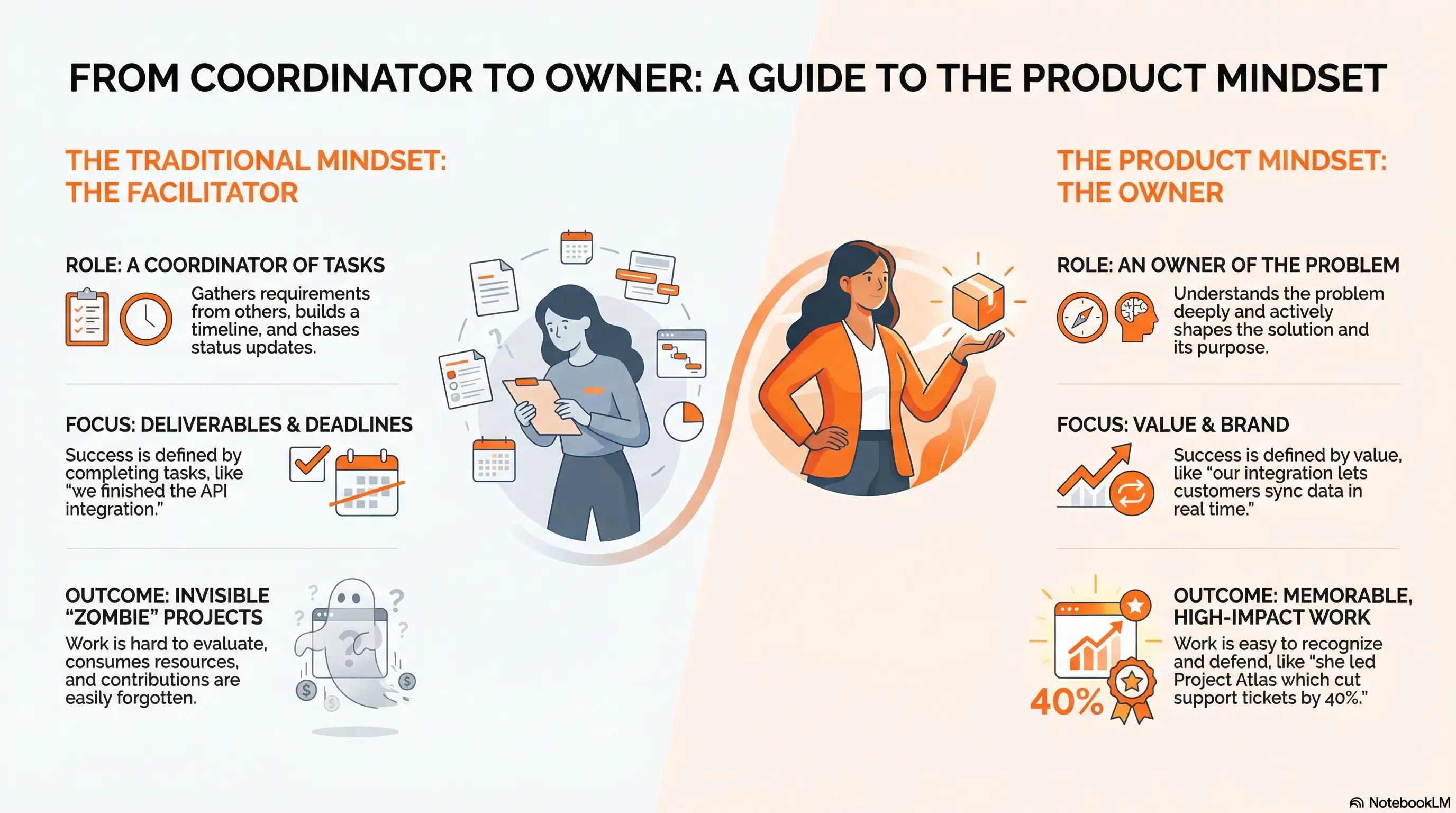
The Product Mindset treats every project as a product worth owning, branding and selling.
A project brand answers the essential questions: What problem are we solving? What is the value proposition? What makes this worth doing now? Projects with strong brands attract resources, create accountability and are easy to evaluate when it is time to prune the portfolio.
Marketing your project is not optional. Stakeholders are customers who will forget and disengage if you do not keep making the case. Well-branded projects also make contributions visible at review time, "she led Project Atlas" is easier to remember and defend than "she worked on some backend stuff."
The project manager who embraces the Product Mindset stops being a coordinator and becomes an owner of the problem, the value and the outcome.
Can you articulate what each project is for?
Clarity Forge gives every project an identity — so your portfolio is legible and easy to evaluate.
Book a DemoStart Free TrialA discussion to see if Clarity Forge is right for your organization.
About the Author
 Michael O'Connor
Founder of Clarity Forge. 30+ years in technology leadership at Microsoft, GoTo and multiple startups. Passionate about building tools that bring clarity to how organisations align, execute, grow and engage.